
In short
Ultra-processed food means ready-to-eat products made with industrial ingredients you would not find in a home kitchen — isolated proteins, modified starches, emulsifiers, artificial flavourings. In a controlled trial at the US National Institutes of Health, participants were offered two diets matched for calories, sugar, fat, fibre and macronutrient split, and could eat as much as they wanted. During the ultra-processed phase they ate an average of 508 calories more per day and gained about 0.9 kg in two weeks; during the unprocessed phase they lost a similar amount.
The definition: the NOVA classification
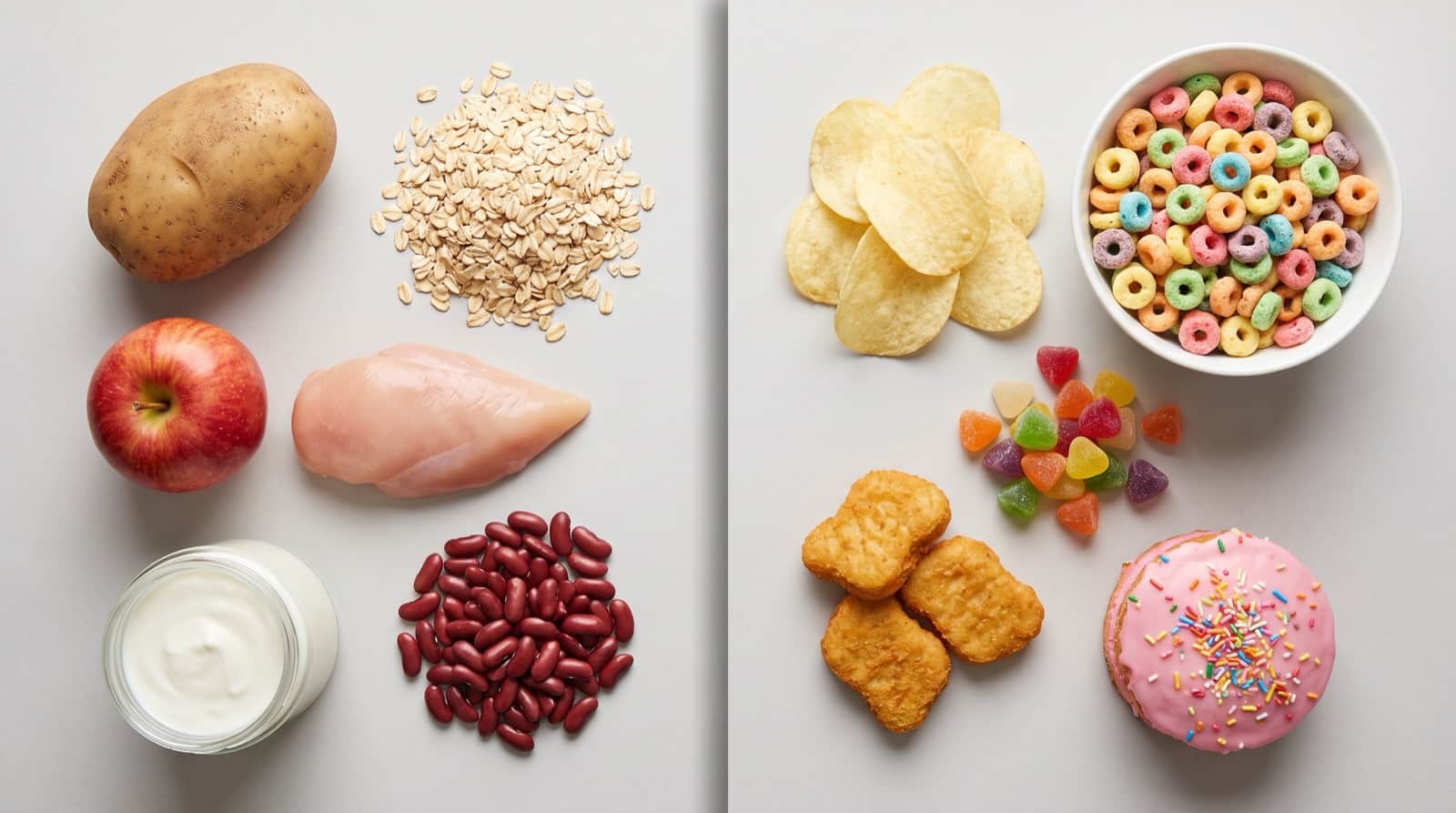
The word "processed" on its own is too broad — frozen broccoli is processed, and so is a packaged cake. The NOVA system, developed in Brazil and now standard in nutrition research, sorts foods into four groups by the purpose and extent of processing.
The key point is this: NOVA looks not at a food’s nutrient content but at how, and why, it was processed. A product can be low in fat, low in sugar and fortified with vitamins and still land in group four.
- Group 1 — Unprocessed or minimally processed: fruit, vegetables, meat, eggs, milk, dried pulses, rice, plain oats.
- Group 2 — Culinary ingredients: olive oil, butter, salt, sugar, honey. Not eaten alone; used to cook with.
- Group 3 — Processed foods: group 1 plus something from group 2 — cheese, sourdough bread, tinned pulses, olives in brine, salted nuts.
- Group 4 — Ultra-processed: contains ingredients absent from home kitchens — isolated protein, hydrolysed starch, invert sugar, emulsifiers, colourings, artificial flavourings, thickeners.
Controlled evidence: same calories, different outcome
Most research in this area is observational and open to the objection that people eating more ultra-processed food may simply eat fewer vegetables. The 2019 trial removed that problem: participants lived on a research ward for four weeks, every meal was weighed in the laboratory, and each person crossed over between the two diets.
The two menus were matched for calories, sugar, fat, sodium, fibre and macronutrient distribution. The only difference was the degree of processing. Participants could eat as much as they liked at each meal, and leftovers were weighed.
The result: an average of 508 extra calories per day during the ultra-processed phase. The excess came mainly from carbohydrate and fat; protein intake was similar in both phases. Weight change tracked the calorie difference — gain during the ultra-processed phase, loss during the unprocessed one.
Why does it make us eat more?
The trial did not isolate a single mechanism, but the differences it measured point to several.
The strongest candidate is eating rate: ultra-processed meals were consumed at more calories per minute. Satiety signals reach the brain in 15-20 minutes; a meal eaten faster delivers more calories before that window closes. Soft texture and low chewing resistance push that rate up directly.
The second factor is energy density: ultra-processed products carry more calories per gram, so the same volume delivers more energy. The third is that combinations of fat, sugar and salt do not occur together in nature — those combinations are engineered in a way that blunts the signal to stop.
"Processed" and "ultra-processed" are not the same thing
This is where the confusion usually sits. Freezing, drying, fermenting and canning are all processing, and they often improve food — tinned chickpeas and sourdough bread both belong on a healthy plate.
| Product | Group | Why |
|---|---|---|
| Plain rolled oats | Minimally processed | Only separated from the grain |
| Flavoured instant oat sachet | Ultra-processed | Flavourings, thickeners, added sugar |
| Tinned chickpeas | Processed | Chickpeas + water + salt |
| Chickpea crisps | Ultra-processed | Isolated starch, flavourings, emulsifiers |
| Plain yoghurt | Minimally processed | Milk + cultures |
| Fruit-flavoured drinking yoghurt | Ultra-processed | Added sugar, colourings, stabilisers |
| Sourdough bread | Processed | Flour, water, salt, starter |
| Packaged sliced sandwich bread | Ultra-processed | Emulsifiers, preservatives, dough conditioners |
A workable approach: you do not have to cut it out
Eliminating ultra-processed food entirely is neither realistic nor necessary for most people. The measured effects operate on proportion: the problem is not one packet of crisps but most of your daily calories coming from this group.
The change with the highest return is to swap the items you eat most. For someone drinking two fizzy drinks a day, those two cans matter far more than a cake once a month.
- Judge by the number of ingredients you do not recognise, not by the length of the list.
- Deal with liquid calories first: fizzy drinks, flavoured milk, energy drinks.
- Target breakfast — it is usually the meal with the highest ultra-processed share.
- Instead of banning convenience products, choose the plain version: plain yoghurt plus fruit, plain oats plus cinnamon.
Frequently asked questions
Does ultra-processed food cause weight gain on its own?
Not through a direct metabolic penalty; the effect shows up as eating more calories. In the controlled trial participants ate an average of 508 extra calories a day on the ultra-processed menu, and the weight gain was explained by that difference. So it is still calories — but the food itself makes those calories easier to consume.
Is protein powder ultra-processed?
Under NOVA, yes — isolated protein falls into group four by definition. But NOVA is a measure of processing, not of health. Protein powder can be useful for someone struggling to reach their protein target; the classification does not forbid it, it just describes what it is.
How can I tell from the label?
A practical rule: if the ingredients list contains something you would never have in your own kitchen (emulsifier, maltodextrin, invert syrup, modified starch, hydrolysed protein, artificial flavouring), the product is probably ultra-processed. It is the type of ingredient that matters, not the number.
Are low-fat or vitamin-fortified products an exception?
No. NOVA looks at processing, not nutrient content; a fortified, low-fat or "light" product can sit squarely in group four. That does not automatically make it harmful, but it does show that "enriched" says nothing about the degree of processing.
Sources
- 1.
Hall KD, Ayuketah A, Brychta R, et al. Ultra-Processed Diets Cause Excess Calorie Intake and Weight Gain: An Inpatient Randomized Controlled Trial of Ad Libitum Food Intake. Cell Metabolism, 30(1), 67-77, 2019. doi:10.1016/j.cmet.2019.05.008
- 2.
Monteiro CA, Cannon G, Levy RB, et al. Ultra-processed foods: what they are and how to identify them. Public Health Nutrition, 22(5), 936-941, 2019. doi:10.1017/S1368980018003762
- 3.
Lane MM, Gamage E, Du S, et al. Ultra-processed food exposure and adverse health outcomes: umbrella review of epidemiological meta-analyses. BMJ, 384, e077310, 2024. doi:10.1136/bmj-2023-077310

Reviewed by
Ecem Akkaba · Dietitian
Dietitian, graduate of İstanbul Medipol University. She develops the recipes and nutrition values on FitZen.