
In short
The recommended daily fibre intake for adults is 25 grams for women and 38 grams for men. In most countries average intake sits around 15-20 grams — roughly half of what is needed. A Lancet review of 185 studies found that people eating 25-29 grams a day had a 15-30% lower risk of all-cause mortality and cardiovascular disease than those eating under 15 grams. Fibre supplies almost no calories but takes up room in the stomach, so the same calories keep you full for longer.
Fibre is not a single substance
Fibre is the collective name for plant carbohydrates that the small intestine cannot digest. That word matters: fibre does not enter the bloodstream as sugar, contributes almost no calories, and passes from stomach to gut largely intact.
It splits into two families that do different work. Soluble fibre forms a gel with water; it slows stomach emptying, flattens the rise in blood sugar and binds bile acids, which lowers LDL cholesterol. Oats, barley, pulses, apples and citrus sit in this group.
Insoluble fibre does not gel. It holds water and adds bulk, speeding transit through the gut and easing constipation. Wholegrain bran, the fibrous parts of vegetables and nuts sit here. Most real foods contain both, which is why variety beats chasing one type.
How much is needed, how much is actually eaten
The reference intakes from the US Institute of Medicine vary by age and sex. The table below puts the target next to typical real-world intake.
The gap is not accidental. Fibre comes almost entirely from plant foods and is stripped out by refining. White flour, white rice and fruit juice are versions of their source with most of the fibre removed.
| Who | Daily target | Typical intake |
|---|---|---|
| Women, 19-50 | 25 g | ~15 g |
| Men, 19-50 | 38 g | ~18 g |
| Women, over 50 | 21 g | ~14 g |
| Men, over 50 | 30 g | ~17 g |
| Children, 4-8 | 25 g | ~11 g |
Why fibre keeps you full
The satiety effect does not come from one mechanism but from four that stack.
First, volume: fibre holds water and occupies space, and stretch receptors in the stomach wall signal fullness to the brain. Second, chewing time: fibrous food takes longer to chew, which gives satiety signals time to arrive. Third, gastric emptying: the gel formed by soluble fibre slows the passage of stomach contents into the intestine. Fourth, fermentation in the colon: gut bacteria convert fibre into short-chain fatty acids, which trigger appetite-suppressing gut hormones.
The practical consequence: a 300-calorie high-fibre meal and a 300-calorie refined meal carry the same energy but do not hold for the same length of time. Counting calories works — but what you count also matters.
Where to find it — what 10 grams looks like
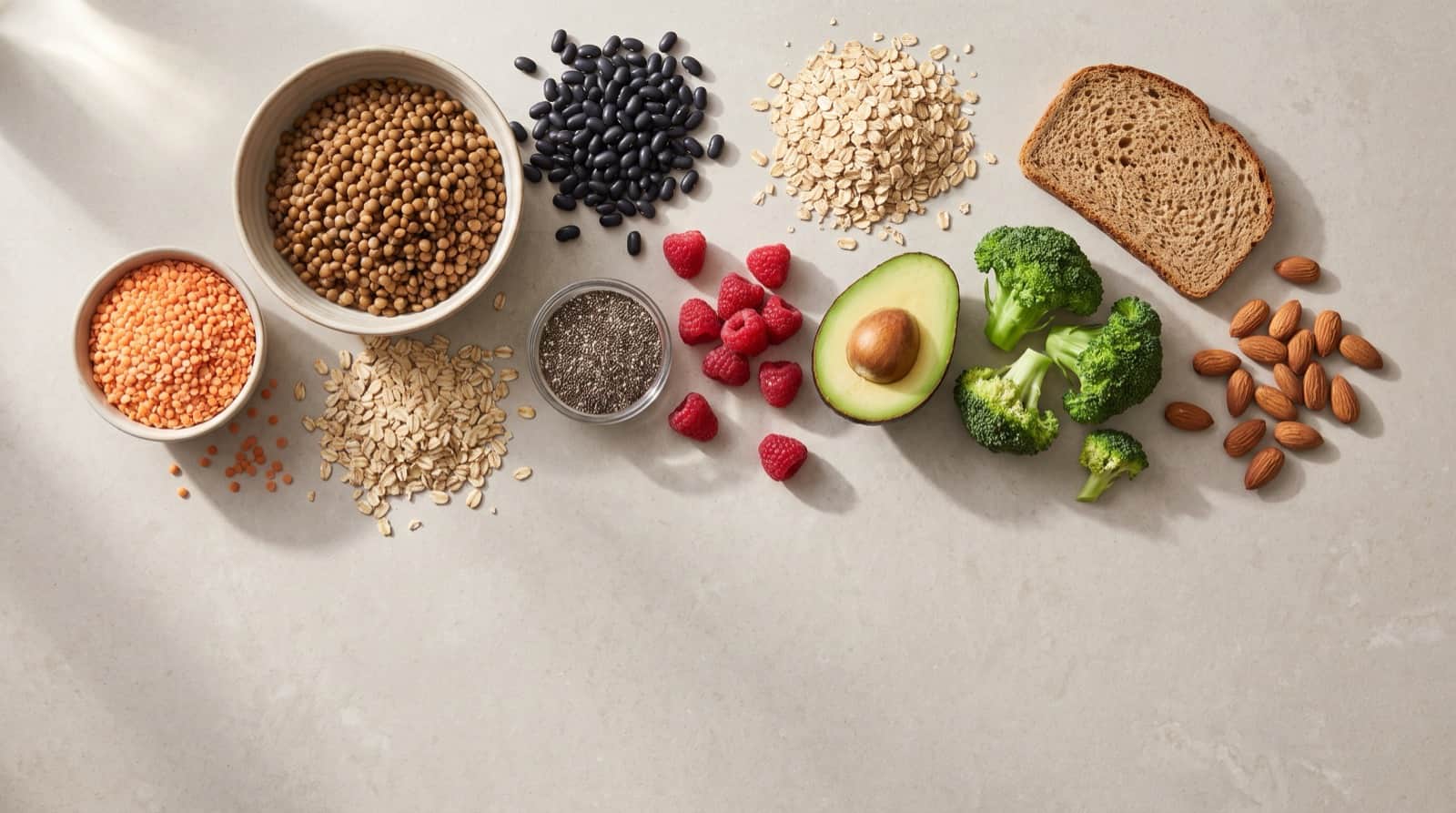
The easiest way to stop treating the fibre target as an abstract number is to know what 10 grams looks like on a plate.
| Food | Amount | Fibre |
|---|---|---|
| Beans/chickpeas, cooked | 1 cup | 12-15 g |
| Lentils, cooked | 1 cup | 15 g |
| Chia seeds | 2 tbsp | 10 g |
| Raspberries/blackberries | 1 cup | 8 g |
| Rolled oats, dry | ½ cup | 4 g |
| Wholegrain bread | 2 slices | 4-6 g |
| Avocado | ½ | 5 g |
| Broccoli, cooked | 1 cup | 5 g |
| Apple, with skin | 1 medium | 4 g |
| Almonds | a handful (30 g) | 3.5 g |
Two mistakes people make when raising it
The first is speed. Going from 15 to 30 grams a day in a week produces gas and bloating — gut bacteria need a few weeks to adapt to the new load. Raising intake by 5 grams a week almost always passes without trouble.
The second is water. Fibre works by absorbing water; raising fibre without raising fluid can worsen constipation rather than relieve it.
A third note: supplements do not fully replace fibre from food. Isolated fibre in a capsule helps transit but brings none of the vitamins, minerals and polyphenols that come with real food. A supplement belongs beside an adequate plate, not on top of an inadequate one.
- Do not raise intake by more than 5 grams a week.
- Increase fluid intake as fibre goes up.
- Wholegrain instead of white flour; whole fruit instead of juice.
- Adding pulses to meals three or four times a week covers half the target on its own.
Frequently asked questions
Does fibre contain calories?
Insoluble fibre supplies almost none. Soluble fibre is fermented in the colon and is counted at roughly 2 calories per gram — less than half of normal carbohydrate. It appears within total carbohydrate on labels, but its energy contribution is small.
Should I take a fibre supplement?
Not if you can reach the target from food. Supplements help with a specific problem such as constipation, or when intake is chronically low, but they do not deliver the other nutrients that come with whole foods. If you do use one, increase water and raise the dose gradually.
Does fibre help with weight loss?
It does not burn fat directly, but it makes a calorie deficit easier to sustain by extending fullness at the same calorie level. Studies link higher fibre intake to weight loss independently of calorie restriction; the mechanism runs largely through appetite.
Should I cut back if fibre makes me bloated?
Usually no — slowing the rate of increase is enough. Bloating is mostly a temporary response while the gut microbiome adapts, and it settles within a few weeks. However, if you have a diagnosis such as irritable bowel syndrome, some fibre types (particularly high-FODMAP ones) may not suit you; speak to a professional in that case.
Sources
- 1.
Reynolds A, Mann J, Cummings J, Winter N, Mete E, Te Morenga L Carbohydrate quality and human health: a series of systematic reviews and meta-analyses. The Lancet, 393(10170), 434-445, 2019. doi:10.1016/S0140-6736(18)31809-9
- 2.
Threapleton DE, Greenwood DC, Evans CEL, et al. Dietary fibre intake and risk of cardiovascular disease: systematic review and meta-analysis. BMJ, 347, f6879, 2013. doi:10.1136/bmj.f6879
- 3.
Slavin JL Dietary fiber and body weight. Nutrition, 21(3), 411-418, 2005. doi:10.1016/j.nut.2004.08.018
- 4.
Institute of Medicine (US), Food and Nutrition Board Dietary Reference Intakes for Energy, Carbohydrate, Fiber, Fat, Fatty Acids, Cholesterol, Protein, and Amino Acids. National Academies Press, Washington DC, 2005. doi:10.17226/10490

Reviewed by
Ecem Akkaba · Dietitian
Dietitian, graduate of İstanbul Medipol University. She develops the recipes and nutrition values on FitZen.