
In short
The official minimum for a healthy adult is 0.8 grams of protein per kilogram of body weight — a floor that prevents deficiency, not a target. While losing weight, 1.6-2.2 g/kg is recommended to protect muscle. For a 70 kg person that means 112-154 grams a day. The daily total matters far more than how you spread it across meals.
Why the official number misleads
The familiar 0.8 g/kg figure is the RDA set by the US National Academies, and its definition is very specific: the amount that prevents deficiency in roughly 97.5% of healthy adults. It is a floor, not a goal.
That distinction matters in practice. When you are in a calorie deficit, training with resistance, or over 65, your protein requirement rises — and staying at the floor accelerates muscle loss in exactly those situations.
- Sedentary adult: 0.8 g/kg — the threshold that prevents deficiency.
- While losing weight: 1.6-2.2 g/kg — to protect muscle in a calorie deficit.
- Regular resistance training: around 1.6 g/kg; no proven benefit above it.
- Over 65: 1.0-1.2 g/kg — to slow age-related muscle loss (sarcopenia).
What that means for your body weight
The table converts those ranges into grams. The “losing weight” column uses 1.9 g/kg, the midpoint of the 1.6-2.2 range recommended for preserving muscle in a deficit.
For people carrying significant excess weight, the calculation is better based on goal weight or lean body mass; using current weight pushes the number higher than necessary.
| Body weight | Minimum (0.8 g/kg) | Losing weight (~1.9 g/kg) |
|---|---|---|
| 55 kg / 121 lb | 44 g | 105 g |
| 65 kg / 143 lb | 52 g | 124 g |
| 75 kg / 165 lb | 60 g | 143 g |
| 85 kg / 187 lb | 68 g | 162 g |
| 95 kg / 209 lb | 76 g | 181 g |
Why protein matters most in a deficit
In a calorie deficit the body does not only burn fat; it also draws on muscle tissue for energy. Raising protein intake is the single strongest lever determining how much of the weight you lose is fat rather than muscle.
The second effect comes through satiety. Protein keeps you full longer than carbohydrate or fat, and its thermic effect is higher: roughly 20-30% of its calories are spent digesting it, against 5-10% for carbohydrate and 0-3% for fat.
The third is discussed less but matters in practice: setting a protein target turns a diet from a list of things not to eat into a list of things to eat. Prohibition lists drain motivation. Targets do not.
How much protein one meal can use
The claim that “the body can only use 30 grams of protein at a time” is common but oversimplified. For stimulating muscle protein synthesis there is a saturation point around 25-40 grams per meal — but protein beyond that is not wasted; it is simply used for other purposes or converted to energy.
The practical conclusion: the daily total is the dominant factor. Spreading it evenly (30-40 grams across 3-4 meals) offers a small additional advantage, but for someone finishing the day at 100 grams, raising the total matters far more than fixing the distribution.
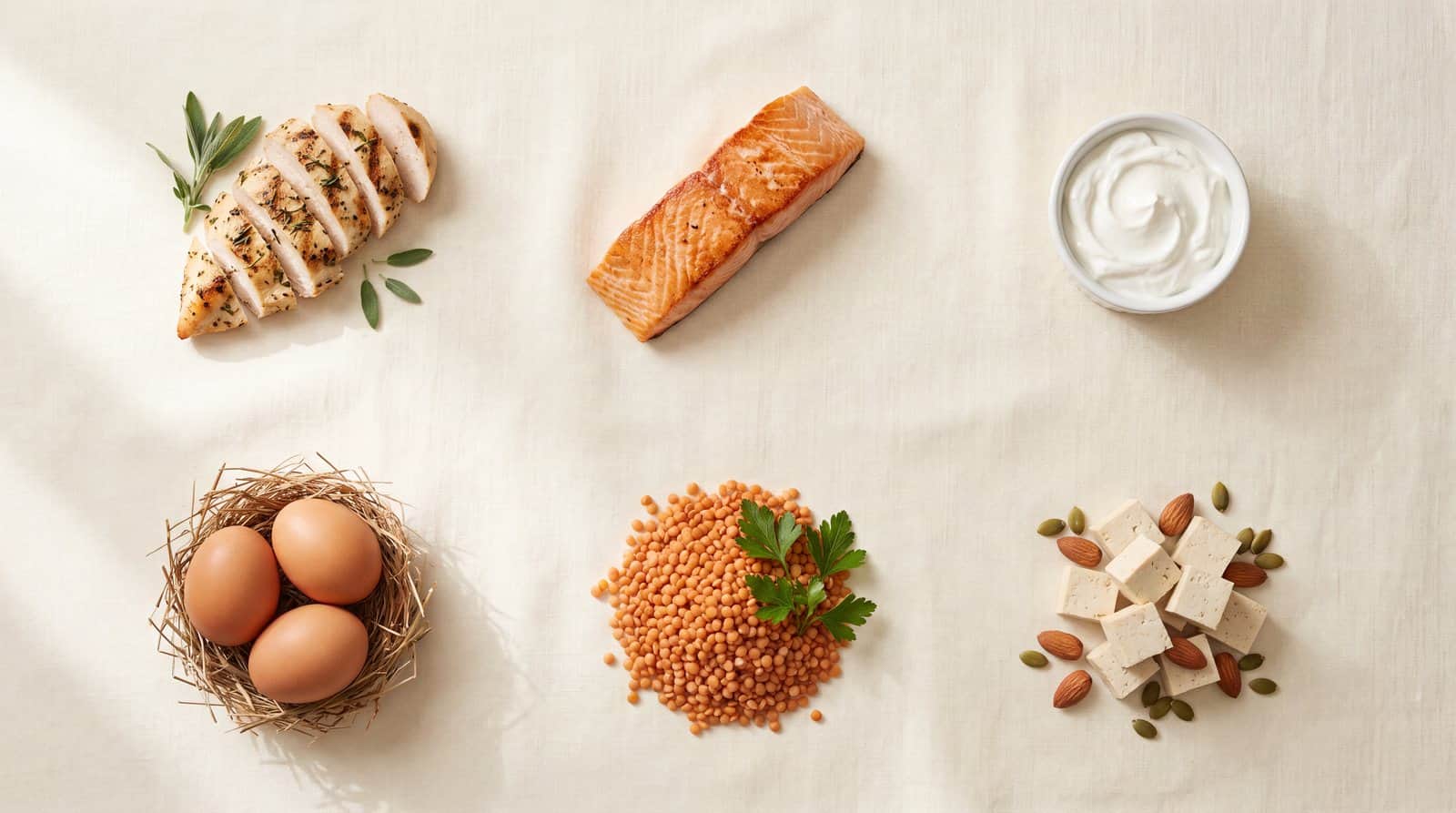
- 150 g chicken breast: ~35 g protein
- 150 g salmon: ~31 g protein
- 200 g Greek yoghurt: ~20 g protein
- 3 eggs: ~19 g protein
- 150 g cooked lentils: ~13 g protein
- 30 g whey powder: ~24 g protein
Is too much protein harmful?
In people with healthy kidneys there is no evidence that high protein intake causes kidney damage. The concern spread by wrongly generalising from patients who already have kidney disease, for whom protein restriction is genuinely useful.
With existing kidney disease, liver failure or gout the situation changes, and protein intake should be set by a physician.
In practice the real ceiling is not physiological but practical: going above 2.2 g/kg is expensive and monotonous for most people, and shows no additional benefit.
Hitting the target on plants
Plant proteins differ in two ways: they are usually less protein-dense per gram, and eaten alone some can be limited in certain essential amino acids. Both are solvable.
The amino acid profile is completed by combining sources across the day — legumes and grains do not need to be in the same meal, variety over the day is enough. Lentils with bulgur, or rice with chickpeas, are the classic examples of this pairing.
- Lentils, chickpeas, beans: 7-9 g per 100 g cooked
- Tofu: ~12 g per 100 g; tempeh: ~19 g
- Quinoa: ~4 g per 100 g cooked, but a complete amino acid profile
- Seitan: ~25 g per 100 g (contains gluten)
- Pumpkin seeds, almonds, peanut butter: 20-30 g per 100 g
Frequently asked questions
I cannot hit my protein target. What should I change?
Focus on breakfast. Most people take the bulk of their protein at dinner and start the day on 5-10 grams. Adding eggs, Greek yoghurt or cheese at breakfast lifts the daily total by 20-25 grams.
Do I actually need protein powder?
No — it is only convenient. If you can reach your target with food there is no added benefit. If 140 grams a day is hard to eat, it makes the job easier. Nutritionally it is not superior to chicken.
Should I calculate on current or goal weight?
If you are carrying significant excess weight, use goal weight. At 120 kg, 1.9 g/kg gives 228 grams, which is more than needed; if your goal is 85 kg, 160 grams is the realistic number.
Does raising protein mean raising calories?
No — you keep total calories the same and change the split, reducing carbohydrate or fat instead. Because protein is more filling per calorie, that swap tends to lower total intake for most people.
Sources
- 1.
Morton RW, Murphy KT, McKellar SR, Schoenfeld BJ, Henselmans M, Helms E, Aragon AA, Devries MC, Banfield L, Krieger JW, Phillips SM A systematic review, meta-analysis and meta-regression of the effect of protein supplementation on resistance training-induced gains in muscle mass and strength in healthy adults. British Journal of Sports Medicine, 52(6), 376-384, 2018. doi:10.1136/bjsports-2017-097608
- 2.
Bauer J, Biolo G, Cederholm T, Cesari M, Cruz-Jentoft AJ, Morley JE, Phillips S, Sieber C, Stehle P, Teta D, Visvanathan R, Volpi E, Boirie Y Evidence-based recommendations for optimal dietary protein intake in older people: a position paper from the PROT-AGE Study Group. Journal of the American Medical Directors Association, 14(8), 542-559, 2013. doi:10.1016/j.jamda.2013.05.021
- 3.
Institute of Medicine, Food and Nutrition Board Dietary Reference Intakes for Energy, Carbohydrate, Fiber, Fat, Fatty Acids, Cholesterol, Protein, and Amino Acids. National Academies Press, Washington DC, 2005. doi:10.17226/10490
- 4.
Leidy HJ, Clifton PM, Astrup A, Wycherley TP, Westerterp-Plantenga MS, Luscombe-Marsh ND, Woods SC, Mattes RD The role of protein in weight loss and maintenance. American Journal of Clinical Nutrition, 101(6), 1320S-1329S, 2015. doi:10.3945/ajcn.114.084038

Reviewed by
Ecem Akkaba · Dietitian
Dietitian, graduate of İstanbul Medipol University. She develops the recipes and nutrition values on FitZen.